


Freedom of Money Transfers
Control when you receive, move, and withdraw your money – not the bank
For decades, money movement has been dictated by banks. Payments could be instant for the customer, but businesses and individuals were forced to wait: next business day, end of the week, or after a bank batch run. In a global, always-on economy, that model is no longer acceptable.
Freedom of money transfers is about changing who controls the timing, flow, and use of funds. With modern digital wallets and payout platforms, payments are no longer locked to bank schedules. Instead, users decide when money moves, how it is paid out, and under which currency conditions.
This is where solutions like NFCPay Wallet, combined with Stripe, represent a fundamental shift in how money works.
From bank-controlled payouts to user-controlled transfers
Traditional Tap to Pay and card-based payment systems usually follow the same pattern:
Payment is accepted
Funds pass through acquirers and banks
Payouts happen on fixed schedules
Currency conversion is often automatic and unavoidable
This works, but it leaves users with very little control. Whether you are a freelancer, a global platform, or a multinational enterprise, you are still waiting on someone else’s clock.
With NFCPay, the logic changes.
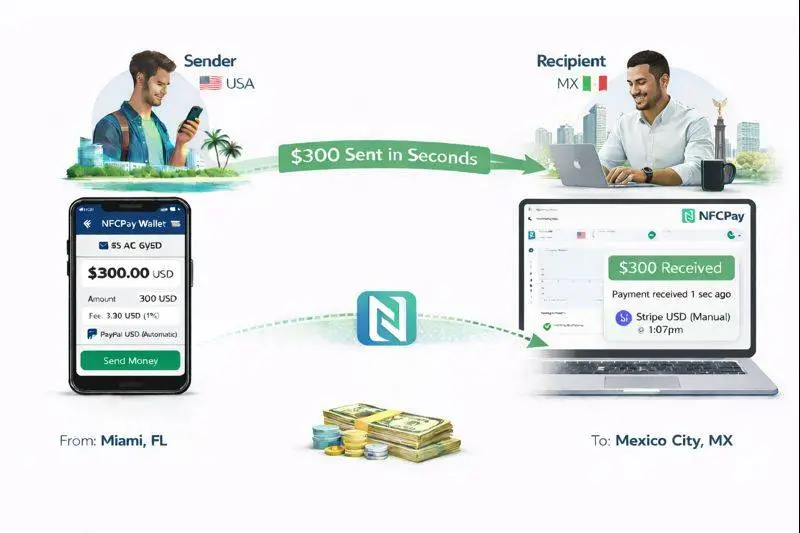
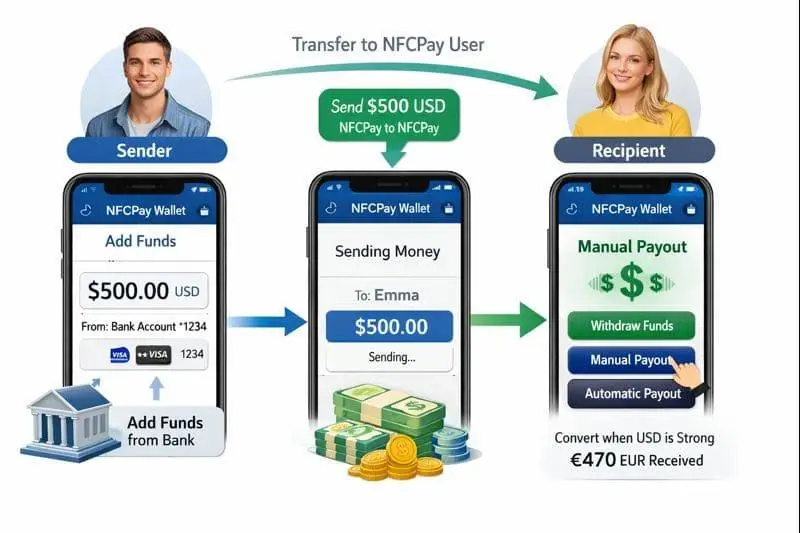
Payments are received into a wallet-driven flow, while payouts are managed through the user’s own Stripe account. That means:
Funds are recognized immediately
The user chooses payout timing
Payouts can be automatic or manual
Capital is no longer forced to move on the bank’s schedule
This is not about removing banks — it’s about moving decision-making to the user.
Tap to Pay is only the entry point
Tap to Pay is often misunderstood as the entire solution. In reality, it’s just the front door.
In the NFCPay model, Tap to Pay (and other payment methods) act as:
A fast way to accept payments
A frictionless user experience
A modern alternative to traditional terminals
But the real value starts after the payment is accepted:
Where does the money go?
When can it be withdrawn?
In which currency?
Under what market conditions?
NFCPay focuses on the full money lifecycle, not just the tap.
Stripe payouts: automatic or manual – your choice
Every NFCPay user connects their own Stripe account. This gives direct access to Stripe’s payout controls, without forcing a one-size-fits-all model.
Users can choose between:
Automatic payouts
Funds are transferred on a recurring schedule
Ideal for predictable cash flow
Minimal manual handling
Manual payouts
The user decides exactly when funds are withdrawn
Full control over liquidity
Strategic timing for larger balances
This flexibility is critical — especially as transaction volumes grow.
Why large enterprises benefit the most
While small businesses benefit from faster access to funds, large companies benefit exponentially more.
At enterprise scale, payments are not just transactions — they are capital flows. Delaying or accelerating a payout by even a short time can:
Improve liquidity ratios
Reduce short-term borrowing needs
Increase interest or yield opportunities
Protect margins during volatile periods
Banks typically don’t offer this level of control by default. Wallet- and platform-based models do.
Currency timing: where real money is made
For global businesses, currency is not a detail — it’s a profit lever.
Imagine a company receiving large volumes in USD, EUR, or GBP:
Automatic conversion locks in whatever rate exists that day
Fixed payouts remove strategic flexibility
Margins are exposed to short-term volatility
With user-controlled payouts through Stripe:
Funds can be held temporarily
Exchange rates can be monitored
Conversion can happen when the currency is favorable
When transaction volumes are high, small percentage differences can translate into significant gains — sometimes more than the operational profit itself.
This is why treasury and finance teams increasingly look for timing control, not just payment acceptance.
A global trend backed by data
Global payment statistics consistently show:
Digital wallets growing faster than traditional card-only flows
Real-time and near-real-time payments becoming the norm
Businesses demanding control over payout timing
Platforms replacing banks as the user experience layer
The expectation is clear:
If the payment is completed, access to funds should not be delayed by legacy systems.
NFCPay is built for this expectation.
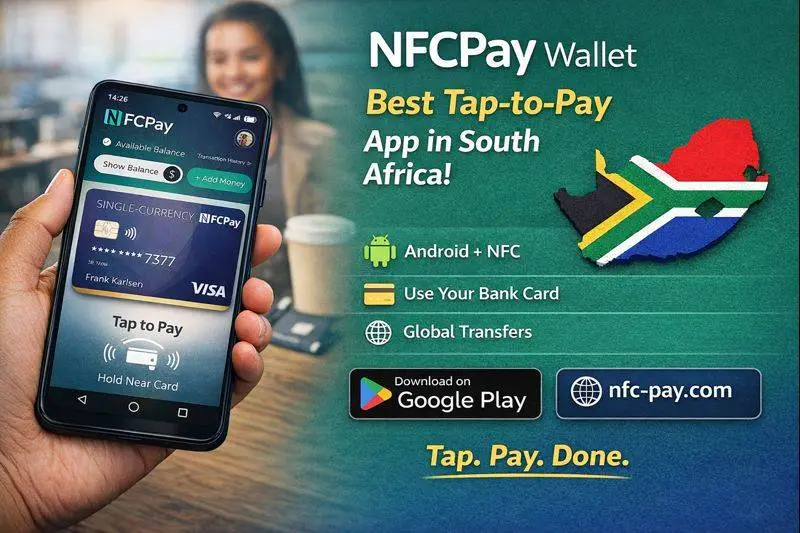
Web and Android: one flow, full control
NFCPay Wallet is designed to work seamlessly across platforms:
Web for administration, monitoring, and payout decisions
Android app for on-the-go payments, transfers, and visibility
No matter the device, users retain:
Visibility over incoming funds
Control over Stripe payouts
Flexibility across currencies and timing
👉 Learn more: https://nfc-pay.com
👉 Download the Android app:
https://play.google.com/store/apps/details?id=net.appdevs.nfcpay&pcampaignid=web_share
Freedom at every scale
For individuals, freedom means:
Getting paid without waiting
Using money immediately
Avoiding bank delays
For businesses, freedom means:
Managing liquidity
Choosing payout timing
Optimizing currency conversion
Turning payment flow into a strategic asset
The larger the amounts, the more valuable this freedom becomes.
Conclusion
Freedom of Money Transfers is not about speed alone.
It’s about control, timing, and choice.
By combining NFCPay Wallet with Stripe’s payout infrastructure, users — from individuals to global enterprises — gain:
Control over when money moves
Flexibility between automatic and manual payouts
The ability to benefit from favorable currency conditions
Independence from rigid bank schedules
In a global, digital economy, money should move on your terms.
And that is exactly what freedom of money transfers means.